https://invisible-island.net/
Copyright © 1997-2024,2026 by Thomas E. Dickey
Lynx is a fully featured World-Wide Web browser for users on both Unix and VMS platforms who are connected to those systems via cursor-addressable, character-cell terminals or emulators. That includes VT100 terminals, and desktop-based software packages emulating VT100 terminals (e.g., Kermit, Procomm, etc.).
The Lynx Development page gives some background on ongoing development.
Before each patch-release, I (usually) do a test-build on Windows. That builds several flavors, which I use in testing. Along with that, since 2007, I have made packages for a few of these executables. Although starting with release 2.8.9, Lynx will build/run as a 64-bit executable, these are 32-bit executables which will run on a 64-bit Windows system:
built with curses (not color-style).
This is the older color-scheme used by Lynx, from 1996. Links and form-fields are colored.
It happens that this flavor of the Windows executables requires OpenSSL to run. Your machine may already have OpenSSL installed; many programs use it. If not, you might find the “light” version from this page useful. While the Lynx Windows installer added support for the SSL libraries in 2017, the Internet Archive shows that the page has been around far longer (first crawled in 2004).
There are two executables, depending on whether you use the “old” or “new” OpenSSL libraries. With Lynx 2.9.3, installers are available for OpenSSL 4 and 3:
You will need these DLLs, either in Lynx's directory or in your system32 directory:
libssl-4.dll
libcrypto-4.dll
These DLLs are used:
libssl-3.dll
libcrypto-3.dll
For both choices, you will need the Microsoft Visual C++ distributables, i.e., vcruntime140.dll (for Visual Studio 2015 or later).
Beginning with
2.8.9dev.17, the installer helps you select the DLLs,
provided that they are in the same directory. It does this by
a file-selection dialog that matches only the SSL-library
(ssleay32.dll or
libssl-1_1.dll).
The other installers do not require OpenSSL, but since
they do not have support for OpenSSL compiled-in, will not
connect to https URLs.
Lynx also builds/works with very old versions of OpenSSL (e.g., 1.0.2), but the OpenSSL developers have abandoned that line of development, and DLLs are no longer offered. Those were named based on the win32 API, which did not make it simple to see if they were actually 64-bit:
libeay32.dll (replaced by
libssl-1_1.dll)ssleay32.dll (replaced by
libcrypto-1_1.dll)In the more recent versions, the names in each case (new, cur) are related to whether the DLLs are 32-bit or 64-bit (in the latter, a “-x64” is inserted).
built with curses (color-style)
The “color-style” refers to the newer scheme where different HTML tags can be colored. It gives a better sense of the page's structure than highlighting links, and has been the default configuration since release 2.8.6 in October 2006.
Both of the curses configurations are built using PDCurses.
built with slang
This is built using the slang library. The color scheme is like the first installer (essentially only coloring links and form-fields), but slang provides brighter background colors in a console window.
In the list below, “release” refers to the latest stable release, while “current patch” is the more recent development version.
I built all of these using Visual Studio on Windows 10 and 11 machines:
They are 32-bit executables (though it is possible to build Lynx as 64-bit executables, I have installed the 32-bit executables on 64-bit operating systems without problems.
The installers should work with Windows 7 or later.
They will not work with older versions of Windows, e.g., Windows XP. See ieshims.dll missing for possible solutions.
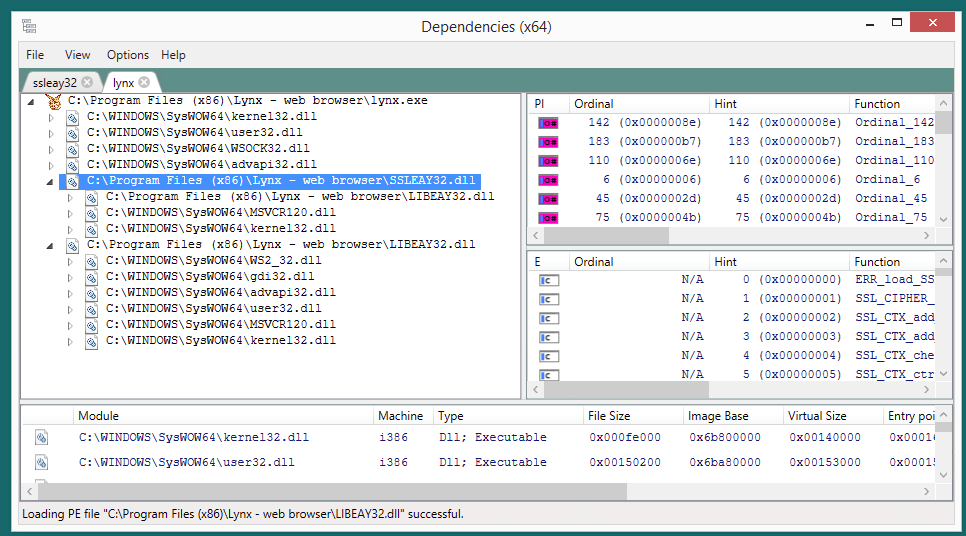
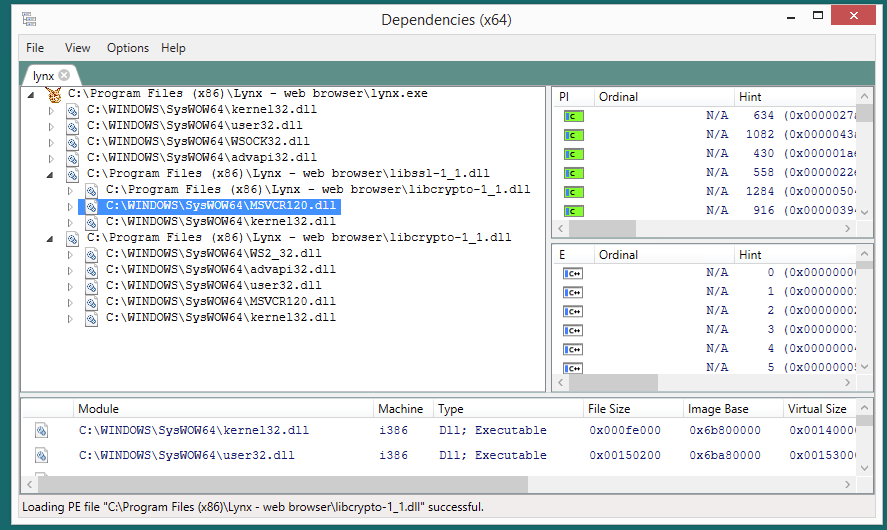
Here are screenshots illustrating the DLL dependencies:
That said, here are links to the Lynx installers on my website:
All files are here: https://invisible-island.net/archives/lynx/